It is September 1996, and the Nintendo 64 has finally arrived in North America with just two games: Pilotwings 64 and Super Mario 64. The launch lineup was tiny, but both titles showed what the new hardware could do. Super Mario 64 in particular became one of the foundational games of modern 3D platforming.
I first played it in early 1997, when my family rented an N64 from Blockbuster. Remember when renting an entire console was a thing? Good times! My friends, my brother, and I traded the controller and made decent progress before the rental was up. Once we got our own N64 later that year, I could finally make the full journey. Nearly 30 years later, the question is whether that journey is still worth taking.
Quick Summary
- Mario’s responsive movement and inventive courses remain the strongest reasons to play.
- The camera and repeated coin hunts are the game’s most noticeable frustrations.
- Its dated graphics do little to diminish the pleasure of exploring Peach’s Castle.
Story
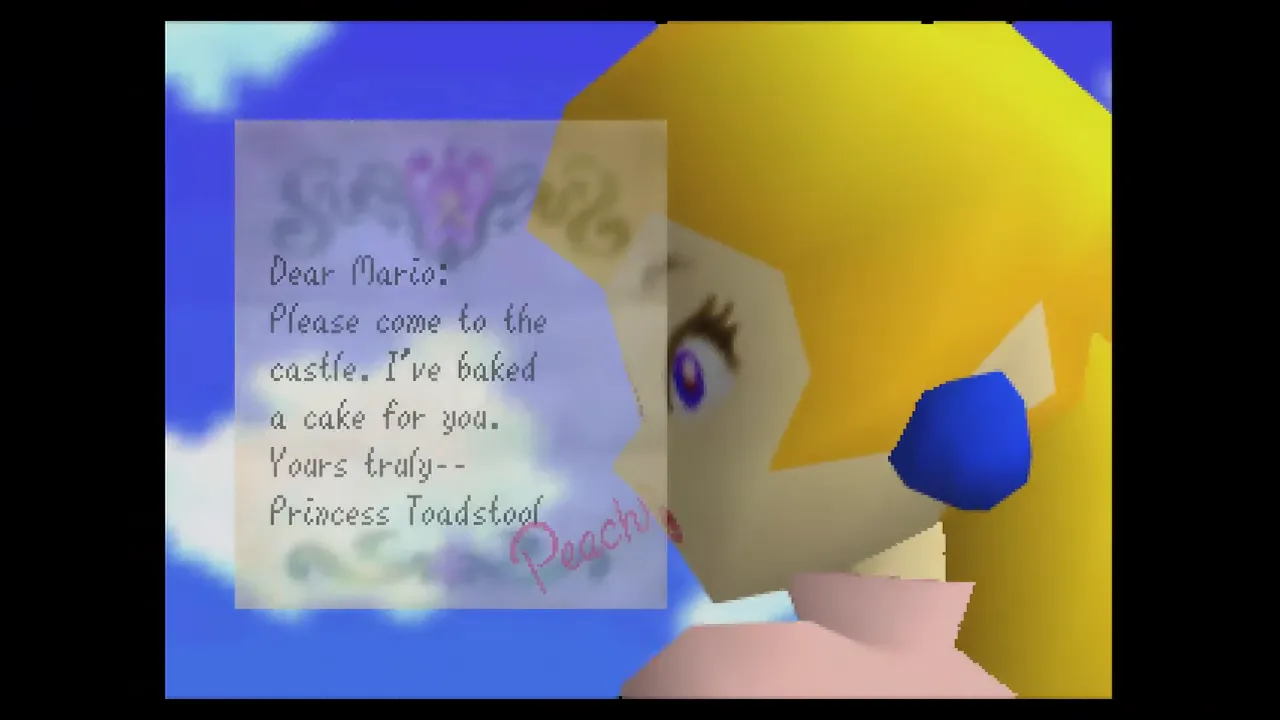
Mario receives an invitation to Princess Peach’s castle for some delicious cake. By the time he arrives, Bowser has kidnapped Peach and stolen the castle’s Power Stars. Mario has to recover them, rescue Peach, and deal with Bowser, all while a Lakitu cameraman follows his every move.
The story is told mostly through text boxes. Peach’s opening letter and the ending are voiced, but cutscenes are practically nonexistent. Events happen within the game’s environments instead. That approach clearly dates Super Mario 64, though it never gets in the way of the adventure.
Gameplay
Super Mario 64 still plays remarkably well. Peach’s Castle acts as a hub for 15 main courses and a handful of secret levels. Most courses are entered by jumping into paintings on the castle walls.
The difficulty builds nicely. Early stages such as Bob-omb Battlefield give you room to experiment, while later courses such as Rainbow Ride present a real challenge without feeling unfairly brutal. It has been fun seeing my own kids work through the game, and they generally cannot stand hard titles. That is, when they are in the mood for an older game at all.
Each main course has six objectives and an optional star for collecting 100 coins. The stages stay distinct through their interactive ideas: Tick Tock Clock plays with time, Tiny-Huge Island changes Mario’s sense of scale, and Wet-Dry World lets you control its water level. Dire Dire Docks even changes after a Bowser encounter, when his submarine disappears. Those touches make relatively compact spaces feel alive and worth exploring thoroughly.
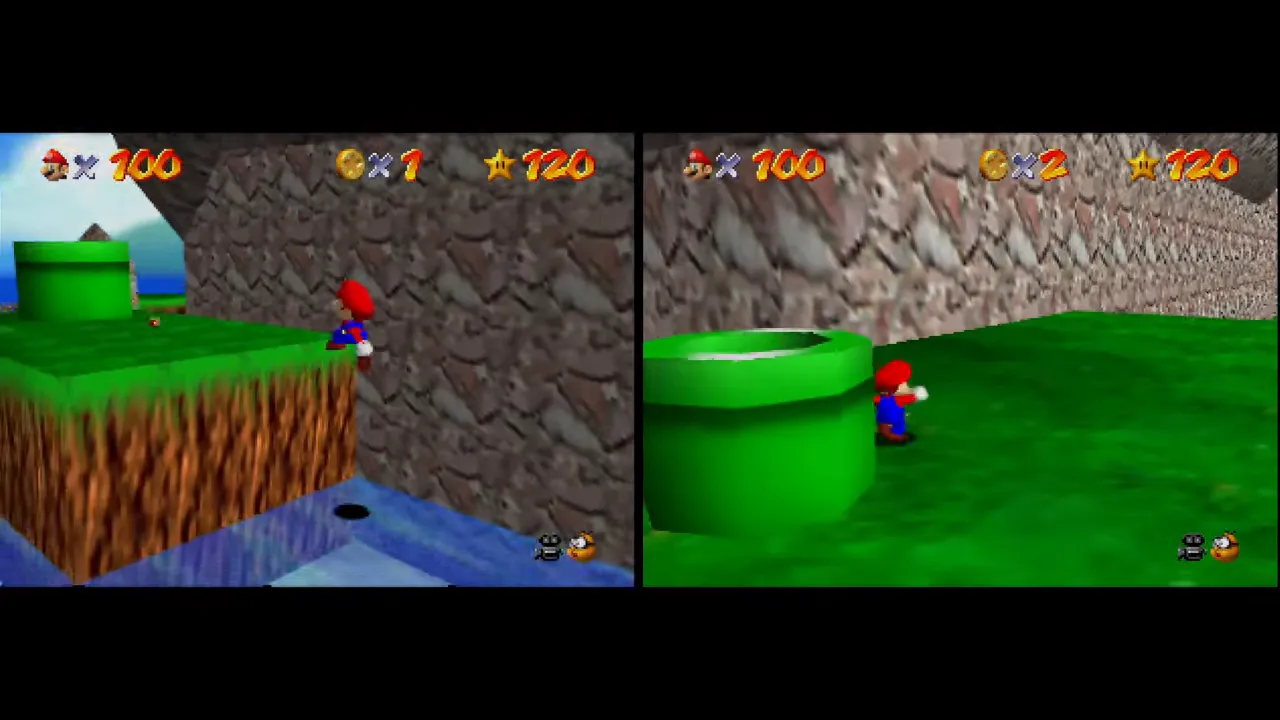
Progression is just as well handled. Power Star milestones open doors to new courses, and the first two Bowser encounters unlock further sections of Peach’s Castle. Eventually, you earn access to the final confrontation with the King of the Koopas.
There is a solid variety of enemies, and Nintendo made an impressive effort to populate these worlds for such an early 3D game. Some levels do this better than others. My personal letdown is the shortage of traditional Koopas. Coming from Super Mario World, where they were everywhere, their limited presence felt like a missed opportunity. The Koopalings are absent altogether.
Movement Is Mario’s Greatest Strength
Walking, running, triple jumps, side jumps, backflips, dives, punches, and ground pounds all feel responsive and satisfying. The analog stick gives Mario excellent movement precision: a gentle push makes him tiptoe, while pushing farther takes him through a walk and jog to a sprint. Holding Z even lets him crawl. It looks funny, but it can be useful.
Learning the full moveset can turn a tough section into something you breeze through. Mastering it completely can make your movement look like absolute witchcraft.
Power-ups add a few more possibilities. The Wing Cap lets Mario fly, the Metal Cap makes him heavy and nearly invincible, and the Vanish Cap turns him invisible. You can also ride a Koopa shell to tear across a level. They are all fun to experiment with, but they appear less often than power-ups in many other Mario games.
Even Mario’s ordinary red cap matters. Lose it and he takes extra damage until you retrieve it, and the cap can remain in a level if you leave or die without picking it up. This was also the first Mario game with a visible life bar. Collecting coins restores health, which I still find hilarious, and coming up for air after swimming underwater fills it back up too.
Visuals
As an N64 launch game, Super Mario 64 looks its age. Characters have relatively few polygons and can appear blocky up close. The console’s texture filtering and limited resolution also leave textures blurry and short on detail.
Despite that, you always know what you are looking at. Bright, vibrant environments are pleasant to explore, while darker stages bring a welcome sense of unease. Playing on a CRT, or using CRT effects through a scaler such as the RetroTink 4K, can do a lot for the game’s overall visual appeal.
Performance on original hardware is generally solid, staying close to 30 frames per second through most of the game, with occasional dips when effects get heavy. Virtual Console and Switch releases provide noticeable visual upgrades and smoother frame rates, although color saturation differences and emulation quirks can crop up. For a launch title, it was an admirable showcase for the N64 and set the stage for later graphical leaps such as Ocarina of Time.
Audio
Working within the limits of an N64 cartridge, the audio team delivered clear music and sound effects. It also made clever use of shared audio assets, including Bowser’s and Boo’s laughs. The soundtrack establishes the atmosphere of each course beautifully, though reused themes mean some worlds sound less distinct than they could have.
This was the first time Mario received a voice in a mainline game, with Charles Martinet beginning a role he would hold for nearly three decades, through Super Mario Bros. Wonder. No, Hotel Mario does not count. His performance is instantly recognizable, and the voice clips sit perfectly alongside the music and effects.
Replayability
Replay value is roughly in line with Mario’s 2D predecessors. Once you have collected all 120 Power Stars, there is not a wealth of additional content. You can still revisit stages on a completed save or start over in another save slot.
A first playthrough can take around 8 to 25 hours, depending on how thoroughly you explore and how comfortable you are with 3D platformers. If chasing personal bests is your thing, the game also has a robust speedrunning scene with plenty of categories.
What It Could Have Done Better
The biggest problem is the camera. The N64’s C-buttons work reasonably well in open spaces, but in tight corridors and rooms the camera can refuse to rotate to a useful angle. That can turn otherwise manageable platforming into clumsy jumps or unnecessary deaths. An alternative Mario camera option helps in some confined areas, but it does not always behave the way you expect.
The collectathon side can wear thin too. Hunting eight red coins and then gathering 100 coins in every course starts to slow the pace after a while. It is also frustrating that collecting each of the six main stars sends you out of a stage and forces you to enter again. The 100-coin star is the exception.
Add in the limited use of power-ups, the scarcity of Koopas, and the absence of Koopalings, and there are a few things I wish Nintendo had done differently. The graphics are dated but mostly functional. Bowser’s model, though? It looks a bit stupid and lacks the menace he had in Super Mario World.
Other Versions
Super Mario 64 has had plenty of life beyond its original cartridge. Japan received a Rumble Pak-enhanced N64 release. Emulated versions appeared on the Wii and Wii U Virtual Console, the Nintendo DS got a full remake, and Switch releases have brought back versions of the N64 game.
The emulation and ROM hacking communities have been busy as well, creating enhancements and total conversions. Kaze Emanuar’s work is particularly worth checking out if you are already a fan. A complete decompilation project has also enabled native ports to other platforms, opening up still more ways to experience the game.
Verdict
Absolutely. Super Mario 64 remains a landmark game that holds up far better than most titles of its era. The camera can be annoying, and the visuals and storytelling unmistakably come from 1996. But Mario’s movement, the clever course design, and the joy of discovering what is behind the next castle door are still excellent.
Whether you play on original hardware, Switch, or an unofficial port, this is easily one of the N64 library’s must-play games. Just be prepared to wrestle the camera now and then.
|
Made with VideoToBlog using Super Mario 64 Review - Still a 3D Platforming Landmark!